
Facing Forward Stories shares real stories from parents and parents-to-be living with chronic illness and disability—highlighting both shared experiences and unique journeys. Through these voices, we offer connection, representation, and encouragement, reminding readers they’re not alone and that there’s no single way to keep facing forward.
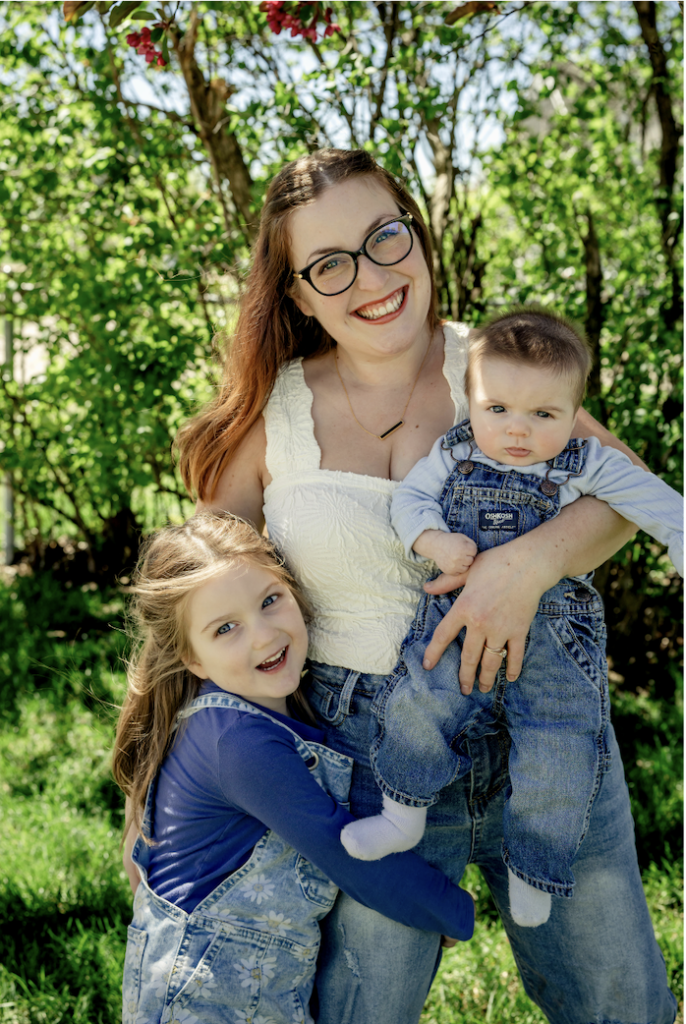
Diagnosed with juvenile idiopathic arthritis at just seven years old, Holly has never known life without chronic illness—but she also hasn’t let it stop her from building the family she dreamed of.
In her Facing Forward Story, Holly shares how she’s learned to replace perfection with self-compassion, embrace creative adaptations, and show her children that listening to their bodies is a strength, not a weakness.
| NAME: Holly PRONOUNS: She / her LOCATION: La Crosse, WI, USA DIAGNOSES: Juvenile idiopathic arthritis into adulthood CHILDREN: Daughter, age 4 and Son, age 6 months! |
What came first for you: chronic illness diagnosis or parenthood?
I was diagnosed with Polyarticular Juvenile Idiopathic Arthritis at age 7. I don’t remember a time in my life where arthritis hasn’t played a part in my daily life. Looking back, I can see seasons of my life where arthritis was in the spotlight; especially during childhood and adolescence.
At age 16, I had my first total hip replacement due to joint damage and severe limits of movement. My second total hip replacement came shortly after at age 18. Arthritis started to become more manageable with weekly biologics or even monthly infusions, which allowed me to live as if arthritis was one part of me and not all-consuming.
I married my husband in 2020 with a perfectly intimate COVID wedding in my parents’ backyard. I had my daughter in 2022 and in January 2026 had a baby boy following two years of secondary infertility.
What have been the biggest challenges you have faced as a parent or parent-to-be living with chronic illness? How have you adapted to those challenges?
One of the biggest challenges I face as a parent with a chronic illness is confronting my own grief as a parent. I felt prior to becoming a parent I had processed what it meant to have arthritis and how I embraced and even celebrated its influence on my identity. When I became a parent, I wasn’t prepared to notice new gaps in my ability. I would have times when I would catch myself thinking “It shouldn’t feel this hard to carry her,” “I’m not doing enough if we don’t do the bath time every night,” or “other moms can just take their kids on a walk and not worry about the physical exhaustion.” Parenting asked me to confront these insecurities and see how it isn’t about being a perfect parent but the just right parent for my kids.
I’ve adapted to these by first giving myself grace; “My children’s basic needs are always met, and they are loved every day.” I stopped comparing myself to some version that wasn’t real and started to notice that I was the type of parent I wanted to be. If there was a day when carrying the kids felt hard, I encouraged my kids to embrace their own skills and “build our muscles” while we held hands on a small walk or as they climbed up the stairs. If there was a time I ran out of spoons before bedtime was over, we could read a story, watch a show, or just have extra cuddles rather than the bath for a night. I talk with my kids about my limits so that rest is not something that is shameful or disappointing but just another way they learn to listen and respond to their bodies. “My body is feeling sore today. I know you wanted to play at the park. Right now, my body says no, but I want to play with you, so let’s pick either play dough or dolls for now”.
What does a typical day look like for you and your family? Are there specific tips or systems that help your family function day-to-day?
Currently, I am juggling a preschooler and a baby, so life is very full! I work four days a week as a mental health therapist, so I try to approach each day with the mindset of “how can I set myself up later for success?“ For example, our preschooler has a visual routine for morning and nighttime. She is working on getting dressed, brushing her teeth, and putting on her shoes before we go. She loves the independence, and it helps relieve the physical load of getting both kids ready.
Another big hack is having a great stroller or wagon for anytime I’m out with the kids. Two little kids mean one (probably both) are going to need to be carried or need my help at some point, so having a place where they can safely be is a huge help. For the baby, having easy-on clothes such as double-zipper sleepers saves my fingers from buttons and his frustration! In nearly every room, there is a safe place to put him down so I’m not constantly trying to make lunch and hold him. Other hacks are: using a delivery or subscription system for diapers to save physical and mental energy! And a second changing station upstairs/downstairs or in the living room to help me not trek back to the nursery several times a day.
How do you talk to your children about your illness?
I’ve started the conversation with my daughter about my arthritis as she is now four and notices differences like how I move, needing to take medicine like shots, and different energy days. I first started with labeling moments like “Mom’s arthritis is loud in my bones today” or “Your body has lots of energy today; Mom’s body needs time to build up energy”. We also talk openly about treatments for arthritis. I give her the job of picking out the Band-Aid or saying encouragement like “You can be brave!” when it’s my biologic shot night or we do yoga stretches together when I need to move gently. Lately we’ve started to talk more about limits and that there are days when my arthritis is loud in my body so I need to do more resting. Together we talk about how it makes sense that we feel disappointment when we change plans and I reassure her that I want to do things with her so we work to make a new plan.
What kind of support has made the biggest difference for you?
The biggest support has been connecting with others. I feel very lucky to have a partner that is very active in parenting with equality. My husband is great at knowing when I might be pushing my own limits and tends to just step in with the kids or remind me that what I’m doing is already enough. I also have been fortunate to meet others with arthritis along the way. As a kid I connected with others at a camp for children with arthritis and then connected with adults in a similar season of life through both social media and the Arthritis Foundation. I currently co-facilitate a parent and fertility connect group with the Arthritis Foundation and I co-host a podcast and Instagram page; Thriving Together, that talks specifically on the intersection of parenting with chronic illness.
What is something you wish more people understood about parenting with chronic illness?
I wish that more people knew that parenting with a chronic illness is something that adds an additional invisible mental load to every day. I think about all the tiny logistics and potential impacts to my chronic illness. It’s like a mental gymnastics routine in my brain. I’m thinking about how to structure the day so that I have enough energy to support my family and not burn myself out. There are the physical impacts like medication, appointments, or therapies, but it is the mental filter of “how will this affect me? Do I have enough energy for that?” Even the choice of having kids had a filter that other able parents may not have.
If you could go back to the day of your diagnosis, what would you tell yourself?
On the day I was diagnosed, I remember the news from the doctor being delivered quite candidly. We needed a rheumatologist because she has arthritis. With my parents loaded up with pamphlets and the referral to a pediatric rheumatologist, we walked down the hallway out of the hospital, and I remember asking what having arthritis meant. My mom said it meant I had this disease, which I assumed she was wrong about because that would mean I was sick. I wasn’t sick; sick meant you got to stay home from school and drink tomato soup. I think I had an image of someone with a disease having something like leprosy, something you could see. She had to be wrong. I didn’t have a disease.
If I could, as my adult self, go back to that moment, I would tell her that she was okay. I would tell her yes, you have arthritis, and that is why your body sometimes has a hard time, but I would remind her that this isn’t bad news. This is helpful news because it means we can figure out what is going to help. I would tell this seven-year-old version of myself that she would still get to do all of the things she could dream of, like: graduate college, become a therapist who helps kids and adults, go on adventures like skydiving, write a children’s book, and be a mom to two kids. If I could go back to that day, I would tell myself to hold on to hope.
What does “facing forward” mean to you?
Facing forward to me means living life with intention and sturdiness. It means embracing all parts of myself without guilt or shame – mom, wife, patient, professional counselor, sister, friend, and writer.
Here’s where you can connect with Holly online!
- YouTube: Thriving Together Podcast
- Instagram: @thrivingtogetherpodcast
| 🌿 Facing Forward Moments: Holly’s Recent Parenting WIN! 🌿 A recent parenting win happened this week with my four-year-old daughter. We are in the peak of Midwest summer, which means 90-degree days filled with humidity. My daughter asked me to play in the pool with her after work, and there was a part of me that wanted to say no because let’s be honest, that’s a lot of work, but I had the energy and said yes. We both swam together, and as she practiced her scoop arms and kicking while holding the wall, I was doing it alongside her! It was a win because we had a great time 1-1, plus I was reminded how my body enjoys the water and can still play with her! |
💛 Want to share your own story? Send an email to: info @ mamasfacingforward.com
💬 Join our community: Mamas Facing Forward Facebook group
